
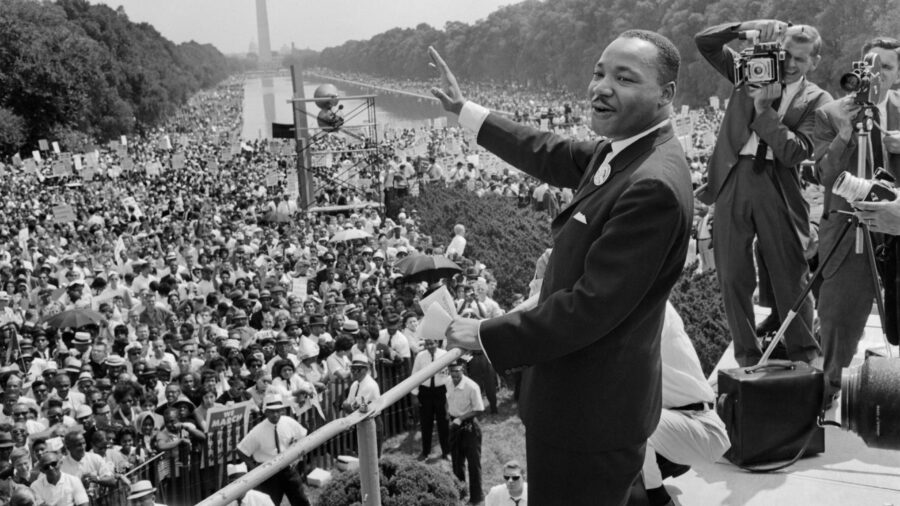
Image courtesy of AFP/Getty Images
Almost 56 years after his death, Doctor Martin Luther King, Jr.’s legacy as a legendary civil rights activist has been disgraced. Today King’s name is most often used by cynical political actors to advance their own agendas.
But King will not simply be a political tool. In addition to being a legendary civil rights leader, King was an unflinching advocate for the poor and exploited—and became one of the most hated men in America for it.
On this MLK Day 2024, enjoy the forgotten history of an American hero.
Martin Luther King, Jr.: The Labor Activist
Doctor Martin Luther King, Jr. is rightly remembered for his role in ending legal segregation in the United States. But what is scrubbed from history is that King was also an avowed labor rights activist.
King was an ally to organized labor throughout his entire adult life, and worked closely with many labor organizations. Speaking at the AFL-CIO Convention, the largest federation of unions in America, King said:
Negroes are almost entirely a working people. There are pitifully few Negro millionaires, and few Negro employers. Our needs are identical with labor’s needs — decent wages, fair working conditions, livable housing, old age security, health and welfare measures, conditions in which families can grow, have education for their children and respect in the community. That is why Negroes support labor’s demands and fight laws which curb labor. That is why the labor-hater and labor-baiter is virtually always a twin-headed creature spewing anti-Negro epithets from one mouth and anti-labor propaganda from the other mouth.
AFL-CIO Convention, December 1961
The full name of the 1963 March on Washington, where King gave his well-known I Have a Dream speech, was “The March on Washington for Jobs and Freedom”. Two union leaders, A. Philip Randolph and Walter Reuther, spoke at the event.
In addition to multiple measures meant to attack segregation in housing, employment, and education, demands of the march included:
From March on Washington organizers’ Bayard Rustin and Cleveland Robinson’s manual, “Organising Manual for the March on Washington for Jobs and Freedom in 1963“
- A massive federal program to train and place all unemployed
workers-Negro and white-on meaningful and dignified jobs at decent
wages.- A national minimum wage act that will give all Americans a decent
standard of living. (Government surveys show that anything less thon
$2.00 an hour foils to do this.)- A broadened Fair Labor Standards Act to include 011 areas of
employment which are presently excluded.
In 1968, King led the Poor People’s Campaign, a campaign that called for the construction of low-income housing, a guaranteed income, and a national jobs program. Just before his assassination, he had arrived in Memphis, Tennessee to support Black sanitation workers on strike for better pay and respect.
Martin Luther King, Jr.: The Revolutionary
Doctor Martin Luther King, Jr. was a critical of the prevailing economic system. He studied and rejected Marxism, seeing it as incompatible with his Christian beliefs, but frequently articulated support for socialist ideas.
In a 1952 letter, King declared to his future wife Coretta Scott that:
I imagine you already know that I am much more socialistic in my economic theory than capitalistic… [Capitalism] started out with a noble and high motive… but like most human systems it fell victim to the very thing it was revolting against. So today capitalism has out-lived its usefulness.
Letter to Coretta Scott, July 18, 1952.
King frequently called for the redistribution of wealth in his speeches. He attacked poverty as evil, and criticized the concentration of wealth and power. In his address to the AFL-CIO convention in December of 1961, King lamented of the dream “yet unfulfilled”:
A dream of equality of opportunity, of privilege and property widely distributed; a dream of a land where men will not take necessities from the many to give luxuries to the few…
Dr. Martin Luther King, Jr. on Labor
Singer and activist Harry Belafonte, who was a close friend of King’s, recalls in his memoir an incident of King forcefully rebutting Andrew Young, another leader in the civil rights movement, on tolerating capitalism a week before King’s assassination:
“I don’t know, Martin,” Young said. “It’s not the entire system. It’s only part of it, and I think we can fix that.” King was having none of it. “I don’t need to hear from you, Andy,’” he clapped back. “You’re a capitalist, and I’m not. The trouble is that we live in a failed system. Capitalism does not permit an even flow of economic resources. With this system, a small privileged few are rich are rich beyond conscience, and almost all others are doomed to be poor at some level. That’s the way the system works. And since we know that the system will not change the rules, we are going to have to change the system.”
UGA Press, “The Prophet of Discontent”, quoting Harry Belafonte’s “My Song: A Memoir”.
Martin Luther King, Jr.: The Anti-War Activist
Doctor Martin Luther King, Jr. was opposed to militarism, calling it one of the three evils alongside poverty and racism. As American involvement in the Vietnam War escalated in the late 60’s, King denounced American militarism in Vietnam.
Though King was opposed to the Vietnam war on economic, religious, and moral grounds, he was weary of criticizing President Lyndon B. Johnson, who had signed the Civil Rights Act of 1964.
Although King “avoided condemning the war outright”, according to Stanford University’s Martin Luther King, Jr. Research and Education Institute, he issued numerous public rebuttals of United States policy in Vietnam. According to the “Vietnam” section of Stanford’s online MLK Institute, King:
- Stated that the war in Vietnam “accomplished nothing” and urged diplomacy in March of 1965 as a settlement to the war
- Called for an end to the bombing in North Vietnam and United Nations mediation to end the war in August of 1965
- Called for a reallocation of funds from Vietnam to domestic anti-poverty programs while testifying before Congress in December of 1966
King attended his first anti-war rally in Chicago in March of 1967, stating:
The bombs in Vietnam explode at home—they destroy the dream and possibility for a decent America…
On April 4th, 1967, exactly one year before his assassination, King gave his seminal speech “Beyond Vietnam”, denouncing the Vietnam war in a congregation of the faithful in New York City. He attacked the war in no uncertain terms, declaring:
A true revolution of values will lay hand on the world order and say of war, “This way of settling differences is not just.” This business of burning human beings with napalm, of filling our nation’s homes with orphans and widows, of injecting poisonous drugs of hate into the veins of peoples normally humane, of sending men home from dark and bloody battlefields physically handicapped and psychologically deranged, cannot be reconciled with wisdom, justice, and love. A nation that continues year after year to spend more money on military defense than on programs of social uplift is approaching spiritual death.
“Beyond Vietnam“
Martin Luther King, Jr.: The Most Hated Man in America
Today, hundreds of millions revere and pay lip service to the ideas of Doctor Martin Luther King, Jr. But near the end of his life, King was widely despised in the United States
After the passage of the Civil Rights Acts of 1964 and 1965, support from Northern White liberals began to wane. Though he believed in nonviolence throughout his career, numerous race riots that had roiled cities across the country were blamed on King, alienating Whites away from his movement.
As King began to broaden the scope of his activism to include anti-poverty and anti-war measures, he lost support from every corner of the United States. In particular, King faced massive backlash after his April 4th speech denouncing the Vietnam War in New York City.
As a 2018 article in The Intercept chronicles, King would never again be invited back to the Johnson White House after the speech. Liberal newspapers like The New York Times and The Washington Post denounced him. The latter paper condescendingly scolded him, writing that King had “diminished his usefulness to his cause, his country and his people.”
Even members of the civil rights movement distanced themselves from King. Some of King’s colleagues rebuked the effort to intertwine civil rights and the anti-war movement, seeing it as a distraction for the struggle for civil rights.
In addition to this, King had been actively surveilled by the FBI since at least 1962. Then-Attorney General Robert Kennedy publicly supported the civil rights movement while privately signing off on FBI Director J. Edgar Hoover’s requests to spy on King under the guise of anti-communism.
From 1962 onwards, King and his associates’ every conversation was recorded. The FBI leaked recordings of King allegedly having extramarital affairs to those around King. The FBI even sent a letter to King that was construed as the FBI encouraging King to kill himself.
In a 1966 poll, King had a 63% disapproval rating. Just 33% of Americans had a positive opinion of him.
Martin Luther King, Jr.: The Hero
This MLK Day, Doctor Martin Luther King, Jr. ought to be remembered as the hero he is. He was smeared and slandered. He was discredited. He was threatened, bombed, and knifed. His allies turned on him. His dream of racial integration failed to materialize, even after the Civil Rights Acts. In the end, he was killed before he could see his life’s work to completion.
And yet he never gave up. King remained a principled and tireless fighter for the poor, for racial equality, for organized labor, and against concentrations of wealth and war, no matter the personal cost to him. He fought for issues that are still affecting Americans almost 56 years later.
On this day, let us abandon the image of King as a political token forever. Instead, let us embrace Doctor Martin Luther King, Jr. as the hero that he is.



 The Enlightenment
Leave a comment