
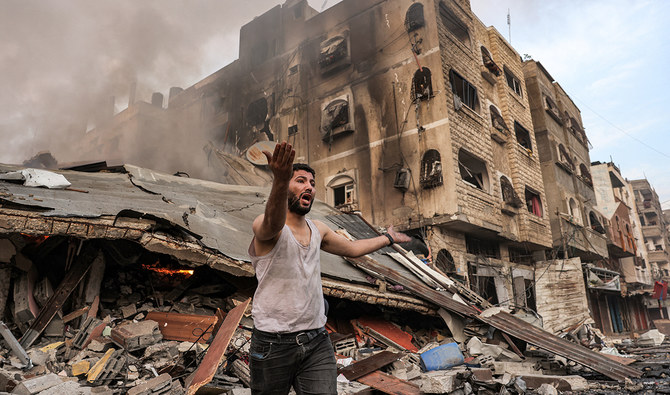
Image courtesy of AFP.
On October 7th, the terrorist group Hamas launched a brutal assault against Israel, killing more than 1,400 civilians and taking almost 200 Israelis hostage. The attacks were savage, with civilians being tortured before being killed and babies being murdered.
In response, calls have come abound, both from within Israel and the West, to “annihilate” Hamas. This is an understandable and noble goal, but the Israeli response in Gaza appears to be to hold all Palestinians collectively responsible for the actions of Hamas.
Israel is conducting regular bombing campaigns of the Gaza strip. Israel has also declared a full “siege” of the Gaza strip and has cut off all power, water, and food going into the Gaza strip, though Israel has resumed the supply of water to Southern Gaza. This siege punishes everyone in Gaza, not just Hamas. Hospitals, for example, will have no electricity to provide critical, life-saving care.
Israeli Prime Minister Benjamin Netanyahu has also ordered the evacuation of Gazans southward as Israel begins its invasion of Northern Gaza, forcing Palestinians to abandon their homes and possessions to go where there is no food, housing, or infrastructure to support the refugee population. The Gaza strip, already a very densely populated area, will be even more packed, increasing deaths and injuries from bombardment. Some Gazans have tried to flee to Egypt via the Rafah crossing, but Israel has been bombing that too.
Over 8,000 Palestinians have been killed so far. Gazans are in a state of humanitarian crisis, with most lacking access to food, water, or basic hygiene products. And yet, Israel is not stopping the siege or the bombings. If we are going to be consistent and hold civilian life to be sacred, then we must also condemn the deaths of innocent Palestinians.
Yes, it is true: Hamas does purposefully hide military infrastructure near civilian areas, leading to higher civilian casualties. But when a spokesman for the Israeli Defense Forces stated that the “emphasis” of the ongoing bombings is “on damage and not on accuracy”, and when one sees the levelling of entire Gazan neighborhoods by bombs, one questions whether the latest Israeli military campaign is truly about targeting Hamas with precision or more about inflicting maximum pain on all Palestinians in Gaza.
The escalating military conflict is not going to end the influence of Hamas or stop terrorist attacks. I can understand a temporary reprisal, or incursion into Gaza, in order for Israel to go tit-for-tat with Hamas, and to secure the release of hostages. But invading or bombing Gaza will not secure Israel. Israel has bombed Gaza many times; none of those bombings have stopped Hamas. Pursuing a policy of what is being termed “collective punishment” of Palestinians will only drive more Palestinians into the arms of Hamas.
It’s important to note that Hamas is deeply unpopular in Gaza. Most Gazans have little or no faith in the Hamas government and believe it to be corrupt. Less than a quarter would vote for the leader of Hamas as president; a plurality of Gazans, 44%, would vote for one of two candidates from the more moderate Palestinian Authority, which governs the West Bank. 30% wouldn’t vote at all. Most Gazans don’t even blame Israel for their decrepit economic conditions. A plurality of Gazans blame Hamas for a lack of food; only 16% blame external sanctions, like the naval and land blockade that Israel currently has on Gaza.
But hidden amongst these numbers is an important caveat: younger and poorer people are more likely to support Hamas than older and wealthier individuals. Support for Hamas is still low, but noticeably higher among Palestinians aged 18-29 compared to those aged 30 or older. The ongoing siege of Gaza and its concurrent economic ruin will radicalize an entire generation of Palestinians towards Hamas.
Thus, rather than endorsing Israel’s indiscriminate bombing campaign in Gaza, the United States, and the West more broadly, must support an immediate ceasefire in Gaza. Not only is the bombing of Gaza contributing to an ever-worsening humanitarian disaster for the Palestinians, but the now-unfolding invasion of Gaza has the immense capacity to escalate into a region-wide conflict that will greatly multiply the loss of life of Israelis and Palestinians.
Despite the lack of support for a ceasefire from American politicos, the idea is very popular with the public. Two-thirds of all Americans support a ceasefire, with majority support across the political spectrum. Some Israelis support a ceasefire, including even an Israeli whose family was killed in the October 7th attacks.
Beyond this temporary ceasefire, we need a UN peacekeeping mission in the area. At this point, neither Hamas nor Israel wants to negotiate with the other, so we must allow tensions to de-escalate as peacekeepers prevent civilian casualties. Israel must stop confiscating Palestinian homes in the West Bank and end the building of settlements in the West Bank, a significant source of aggrievement for the Palestinians, and return all current settlements and land to the Palestinians. Likewise, Hamas must stop launching terrorist attacks into Israel.
What we must NOT be doing is banning pro-Palestinian protests (as is happening in France and Germany) and firing political appointees for calling for a ceasefire (as is happening in the United Kingdom).
The October 7th terrorist attack was truly savage, committed by a savage organization. The Israeli loss of life was unspeakable. But the continued, unrestricted bombing of Gaza is not going to eliminate Hamas. On the contrary: by killing thousands of Palestinian civilians, Israel is only going to bolster support for Hamas and, ironically, precipitate another terrorist attack against Israeli civilians.
Now, as Israel deploys boots on the ground in Gaza, the decades-long cycle of terrorism and reprisal between Israel and Palestine is threatening to grow in scale and destabilize the entire Middle East. The only sensible path forward is a ceasefire, and President Biden must immediately call for one.

 The Enlightenment
Leave a comment